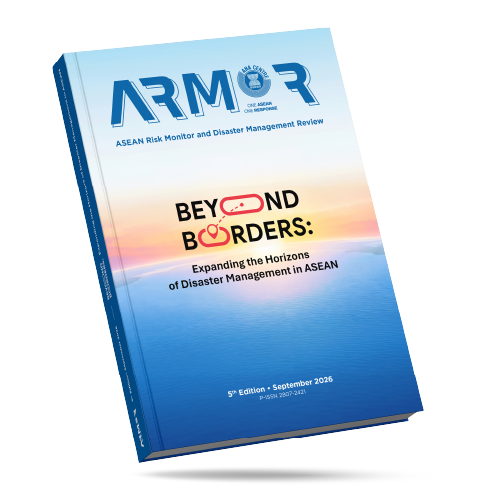

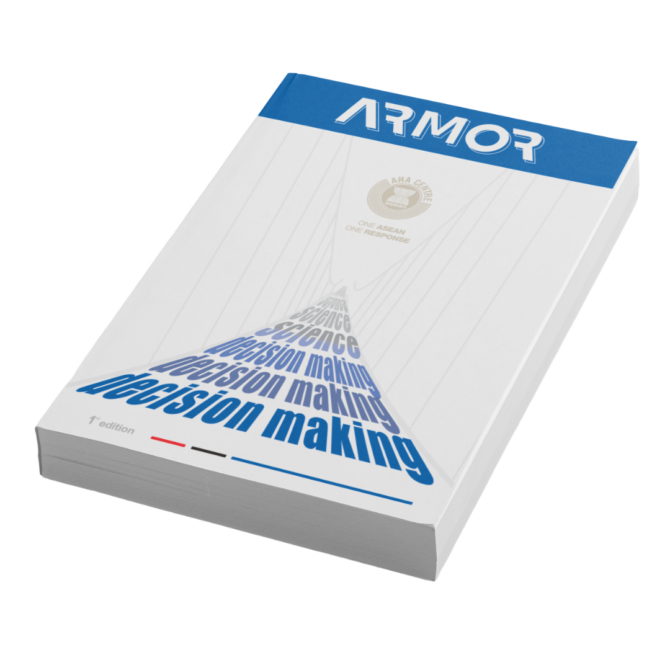
ARMOR 5th Edition Beyond Borders Expanding the Horizons of Disaster Management in ASEAN

ARMOR 5th Edition - Beyond Borders: Expanding the Horizons of Disaster Management in ASEAN

ISSN: 2807-2421

DOI: https://doi.org/10.62508/aha.armor.v5-2026


Southeast Asia remains the world’s most disaster-prone region, and the nature of that risk is changing. More than 90% of disasters in the region are hydrometeorological, such as storms, floods, and droughts, and their frequency continues to rise. Climate change is also intensifying other hazards, including heatwaves and rising sea levels, while the risk of human-induced hazards, such as natural hazard-triggered technological accidents, further compounds these pressures.

In 2024 alone, Typhoon Yagi affected ASEAN Member States—including Lao PDR, Myanmar, the Philippines, Thailand, and Viet Nam—demonstrating that the region’s risk landscape increasingly transcends national borders. As climate change intensifies both the frequency and interconnectedness of hazards, transboundary flooding, tropical cyclone corridors, and cascading regional crises are increasingly common, exposing the limitations of disaster planning organised primarily along national lines.

This shift coincides with a period of transition for the region. With the ASEAN Vision 2025 on Disaster Management now concluded, ASEAN is transitioning to its next phase of regional cooperation: the ASEAN Agreement on Disaster Management and Emergency Response (AADMER) Work Programme 2026–2030.

In our continued mission to support ASEAN’s collective disaster management goals, we present the 5th edition of the ASEAN Risk Monitor and Disaster Management Review (ARMOR) as our contribution to shaping this next cycle, mapping current risks and identifying potential solutions as the region moves beyond its 2025 vision. This edition was produced with the support of the New Zealand Ministry of Foreign Affairs and Trade, through the Strengthening Institutional Capacity of ASEAN in Disaster Management (SICAP) Phase II Project, and reflects our continued collaboration with the ASEAN Secretariat and the region’s disaster management community.

ARMOR 5th Edition is titled Beyond Borders: Expanding the Horizons of Disaster Management in ASEAN. The theme reflects three interconnected dimensions of that expansion: disaster risk considered beyond geographical borders, encompassing multi-hazard exposure and shared regional resilience; policy and stakeholder cooperation extended beyond institutional borders, both within ASEAN and with external partners; and technological and social innovation pursued beyond the borders of existing practice. Together, the eight articles in this edition examine how ASEAN can strengthen regional resilience by working across these borders.

Beyond Borders: Introducing Transboundary Risk and Resilience into the ASEAN Riskscape introduces a transboundary component to ASEAN RISK, ARMOR’s composite disaster risk index. The article proposes extending it beyond its prior country-level assessments to capture exposure to shared river basins and tropical cyclone corridors, and demonstrates the measurable effect that transboundary hazard exposure and cooperation have on Member States’ overall risk profiles.

Five Years On: The Changing Dimensions of Drought Risk in Southeast Asia examines how the character of drought risk has evolved in the five years since the 2020 ASEAN Ministerial Declaration on the Strengthening of Adaptation to Drought, highlighting the growing prevalence of rapid-onset “flash droughts” and the implications of these changes for early warning systems and anticipatory action across the region.

Resilience Without Borders: Building Regional Readiness through Local Solutions in Malaysia and Viet Nam explores how governments and non-governmental organisations in the two Member States are strengthening community-based urban flood response, with particular attention to older persons, offering practical and regionally scalable models for cross-border disaster resilience.

From Imagination to Action: Youth-Led Futures Literacy for Cross-Border Resilience in ASEAN examines the role of futures literacy in empowering ASEAN youth to lead cross-border collaboration, drawing on a regional youth workshop that brought together participants from 14 countries to demonstrate how participatory, forward-looking approaches can strengthen the region’s anticipatory capacity.

Integrating and Upscaling Cultural Heritage and Social Innovation in Coping with Flooding and Drought across Southeast Asia synthesises the potential of cultural heritage and social innovation to support communities coping with flooding and drought, illustrated through a case study of Indonesia’s traditional retention ponds and their integration with contemporary technologies such as the Internet of Things.

ASEAN Resilience Living Lab: Mainstreaming Resilience Culture in Transboundary Disaster Recovery proposes the ASEAN Resilience Living Lab, a regional framework for operationalising systemic, transboundary resilience that draws on lessons from Typhoon Rai and the 2021 Hulu Langat floods to bridge disaster response and sustainable development.

Shaping Inclusive Regional Disaster Management: Protection, Gender, and Inclusion in Transboundary Scenario examines how a Protection, Gender, and Inclusion lens can be embedded within transboundary disaster contexts, highlighting pathways for strengthening inclusive, coordinated, and sustainable disaster governance across the region.

Utilisation of Space-based Information for Understanding Transboundary Risk and Supporting Emergency Response and Early Recovery in ASEAN presents a six-year update on ASEAN’s use of space-based information through Sentinel Asia, a voluntary regional collaboration connecting the space and disaster management communities. The article outlines its contributions to regional emergency response and offers recommendations for strengthening coordination between space agencies and disaster management agencies under the AADMER Work Programme 2026–2030.

Together, these eight articles reflect a shared recognition that disaster risk in Southeast Asia can no longer be addressed within national boundaries alone. By examining risk, response, and innovation across our borders, this edition of ARMOR aims to inform the region’s collective approach to disaster management as ASEAN enters the next phase of the AADMER Work Programme, and to support the region’s continued pursuit of sustainable transboundary resilience for all its Member States and communities.