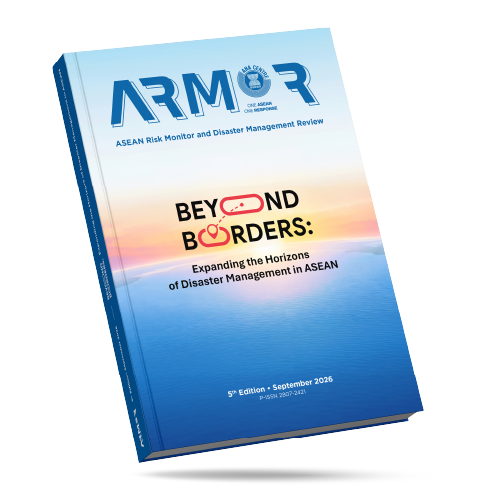
ARMOR 5th Edition - Beyond Borders: Expanding the Horizons of Disaster Management in ASEAN

AHA Centre - 2807-2421
Digital Object Identifier

Description

Southeast Asia's disaster risk landscape is increasingly transboundary in nature. More than 90% of disasters in the region are hydrometeorological, and climate change is intensifying the frequency and severity of hazards such as tropical cyclones, floods, and droughts, many of which cross national borders. Tropical Cyclone YAGI, which struck Lao PDR, Myanmar, the Philippines, Thailand, and Viet Nam in 2024, underscored this reality, as did the 4th Disaster Scenario of the ASEAN Joint Disaster Response Plan (AJDRP) on transboundary flooding in the Lower Mekong Basin, projected to affect more than 8.8 million people across Cambodia, Lao PDR, Thailand, and Viet Nam. In response, ASEAN Member States (AMS) are working to strengthen early action, regional cooperation, and transboundary response mechanisms, from expanding disaster scenarios under the AJDRP to exploring disaster financing, promoting Sex, Age, and Disability Disaggregated Data (SADDD), and leveraging Artificial Intelligence and Machine Learning for cross-sectoral risk mitigation. The AHA Centre, through the ASEAN Risk Monitor and Disaster Management Review (ARMOR), presents the 5th edition of this publication under the theme “Beyond Borders: Expanding the Horizons of Disaster Management in ASEAN.” The 5th edition brings together contributions that examine disaster risk, policy and stakeholder cooperation, and technological and social innovation beyond geographical, institutional, and innovation borders. Collectively, the articles aim to inform ASEAN's post-2025 vision for disaster management and the development of the AADMER Work Programme for 2026 onwards. Beyond Borders: Introducing Transboundary Risk and Resilience into ASEAN Riskscape This chapter introduces a transboundary component into ASEAN RISK, the composite disaster risk index featured in ARMOR. Building on prior work identifying shared river basins and tropical cyclone corridors as the region's clearest transboundary hazard pathways, the chapter constructs a Transboundary Hazard Multiplier and extends the SDG-adjusted resilience approach through an indicator on transboundary water cooperation. The results show a measurable increase in RISK for most Member States once transboundary hazard exposure is accounted for, and a reduction in RISK for Mekong riparian states with available cooperation data. The chapter is presented as a demonstration of method, and points to extending data coverage, incorporating climate projections, and strengthening regional cooperation as priorities for future risk assessments. Five Years On: The Changing Dimensions of Drought Risk in South-East Asia since the 2020 ASEAN Ministerial Declaration on the Strengthening of Adaptation to Drought This chapter examines how the characteristics of drought risk in South-East Asia have evolved in the five years since the 2020 Ministerial Declaration on Strengthening Adaptation to Drought. It highlights a shift toward rapid-onset “flash” droughts, or “thirstwaves,” driven by warming trends, shifting monsoon patterns, and rising evapotranspiration, even in the absence of El Niño–Southern Oscillation conditions. The article considers what this shift means for drought early warning and anticipatory action, and recommends recalibrating monitoring tools and strategies through satellite-based monitoring, early warning systems, and AI-driven drought risk analysis as ASEAN moves into the AADMER Work Programme 2026–2030. Resilience Without Borders: Building Regional Readiness through Local Solutions in Malaysia and Vietnam This chapter explores how urban flooding, intensified by rapid urbanisation, climate change, and an ageing population, calls for disaster management that is adaptive, inclusive, and collaborative. Drawing on focus group interviews in Vietnam and Malaysia, the chapter showcases community-based strategies, such as neighbourhood early warning systems and social support networks, that have proven particularly effective in reaching senior citizens. The findings offer practitioners replicable, locally grounded solutions and demonstrate to policymakers the value of linking grassroots innovation to regional instruments such as the AADMER Work Programme and the Sendai Framework, reinforcing the case for deeper cross-border collaboration and shared governance. From Imagination to Action: Youth-Led Futures Literacy for Cross-Border Resilience in ASEAN This chapter explores the role of futures literacy, as championed by UNESCO, in empowering youth to lead cross-border collaboration on disaster risk reduction. Drawing on the 3rd International Workshop on Youth and Young Professionals for Disaster and Climate Resilience, which convened participants from 14 countries, the chapter applies Futures Literacy Lab methodologies to surface probable, desirable, and reframed futures for the region. It recommends embedding futures literacy into education and governance, engaging youth in policymaking, strengthening multi-sectoral Pentahelix partnerships, and adopting innovative financing tools such as resilience bonds, in line with the Sendai Framework and AADMER Work Programme. Integrating and Upscaling the Cultural Heritage and Social Innovation in Coping with Flooding and Drought across Southeast Asia This chapter synthesises the potential of indigenous cultural heritage and social innovation to help Southeast Asian communities cope with flooding and drought, an evidence base the chapter notes remains limited in the region. It presents a case study of Embung, community-based retention ponds and gravity-fed irrigation systems dating to the 8th century that have expanded from Cambodia to Indonesia, and examines how this traditional practice has been integrated with contemporary Internet of Things technology to manage water allocation across wet and dry seasons. The chapter closes with a discussion of how such indigenous knowledge can be upscaled and integrated into disaster management frameworks across the region. ASEAN Resilient Living Lab: Mainstreaming Resilient Culture in Transboundary Disaster Recovery This chapter argues that the escalating complexity of transboundary disasters in ASEAN, illustrated by Typhoon Rai's cascading impacts across the Philippines and Southern Thailand and the 2021 Hulu Langat floods that displaced 71,000 people in Selangor, demands a shift toward systemic resilience thinking. The chapter synthesises multi-dimensional disaster impacts, spanning physical damage, economic loss, and socio-humanitarian challenges, to expose systemic gaps in early warning, urban planning, and post-disaster equity. It then develops the ASEAN Resilience Living Lab (ARLL), a regional framework aligned with the Humanitarian Development Nexus that draws on community-driven innovation, real-time satellite monitoring, and transboundary policy harmonisation, while also addressing the intangible, spiritual dimensions of disaster recovery. Shaping Inclusive Regional Disaster Management: PGI in ASEAN's Transboundary Scenario This chapter examines how a Protection, Gender, and Inclusion (PGI) lens can be operationalised within ASEAN's transboundary disaster contexts. Taking the AJDRP's fourth regional disaster scenario on transboundary flooding in the Lower Mekong Basin as an entry point, the chapter identifies persistent gaps in current disaster management systems, including an overemphasis on response over prevention and recovery, and limited attention to the needs and capacities of groups such as persons with disabilities and elderly people, who are often treated as recipients of assistance rather than active contributors. Drawing on regional frameworks and initiatives, the chapter outlines pathways for more people-centred, inclusive, and coordinated disaster governance across ASEAN. Utilisation of Space-based Information for Emergency Response in ASEAN This chapter provides a six-year update on the collaboration between the space and disaster management communities in ASEAN under Sentinel Asia, a voluntary initiative of the Asia-Pacific Regional Space Agency Forum that connects 127 organisations, 49 of them based in Southeast Asia. It reviews how Emergency Observation Requests (EORs), of which ASEAN Member State entities have accounted for more than half on average since 2007, have supported preparedness and emergency response, and examines recent advances in space-based observation for assessing transboundary risk. The chapter recommends strengthening coordination between space agencies and disaster management agencies to support the AADMER Work Programme 2026–2030 and the Sentinel Asia Strategic Plan 2021–2027.

Abstract

Southeast Asia's disaster risk landscape is increasingly transboundary in nature. More than 90% of disasters in the region are hydrometeorological, and climate change is intensifying the frequency and severity of hazards such as tropical cyclones, floods, and droughts, many of which cross national borders. Tropical Cyclone YAGI, which struck Lao PDR, Myanmar, the Philippines, Thailand, and Viet Nam in 2024, underscored this reality, as did the 4th Disaster Scenario of the ASEAN Joint Disaster Response Plan (AJDRP) on transboundary flooding in the Lower Mekong Basin, projected to affect more than 8.8 million people across Cambodia, Lao PDR, Thailand, and Viet Nam. 


In response, ASEAN Member States (AMS) are working to strengthen early action, regional cooperation, and transboundary response mechanisms, from expanding disaster scenarios under the AJDRP to exploring disaster financing, promoting Sex, Age, and Disability Disaggregated Data (SADDD), and leveraging Artificial Intelligence and Machine Learning for cross-sectoral risk mitigation. The AHA Centre, through the ASEAN Risk Monitor and Disaster Management Review (ARMOR), presents the 5th edition of this publication under the theme “Beyond Borders: Expanding the Horizons of Disaster Management in ASEAN.” 


The 5th edition brings together contributions that examine disaster risk, policy and stakeholder cooperation, and technological and social innovation beyond geographical, institutional, and innovation borders. Collectively, the articles aim to inform ASEAN's post-2025 vision for disaster management and the development of the AADMER Work Programme for 2026 onwards. 


Beyond Borders: Introducing Transboundary Risk and Resilience into ASEAN Riskscape 


This chapter introduces a transboundary component into ASEAN RISK, the composite disaster risk index featured in ARMOR. Building on prior work identifying shared river basins and tropical cyclone corridors as the region's clearest transboundary hazard pathways, the chapter constructs a Transboundary Hazard Multiplier and extends the SDG-adjusted resilience approach through an indicator on transboundary water cooperation. The results show a measurable increase in RISK for most Member States once transboundary hazard exposure is accounted for, and a reduction in RISK for Mekong riparian states with available cooperation data. The chapter is presented as a demonstration of method, and points to extending data coverage, incorporating climate projections, and strengthening regional cooperation as priorities for future risk assessments. 


Five Years On: The Changing Dimensions of Drought Risk in South-East Asia since the 2020 ASEAN Ministerial Declaration on the Strengthening of Adaptation to Drought 


This chapter examines how the characteristics of drought risk in South-East Asia have evolved in the five years since the 2020 Ministerial Declaration on Strengthening Adaptation to Drought. It highlights a shift toward rapid-onset “flash” droughts, or “thirstwaves,” driven by warming trends, shifting monsoon patterns, and rising evapotranspiration, even in the absence of El Niño–Southern Oscillation conditions. The article considers what this shift means for drought early warning and anticipatory action, and recommends recalibrating monitoring tools and strategies through satellite-based monitoring, early warning systems, and AI-driven drought risk analysis as ASEAN moves into the AADMER Work Programme 2026–2030. 


Resilience Without Borders: Building Regional Readiness through Local Solutions in Malaysia and Vietnam 


This chapter explores how urban flooding, intensified by rapid urbanisation, climate change, and an ageing population, calls for disaster management that is adaptive, inclusive, and collaborative. Drawing on focus group interviews in Vietnam and Malaysia, the chapter showcases community-based strategies, such as neighbourhood early warning systems and social support networks, that have proven particularly effective in reaching senior citizens. The findings offer practitioners replicable, locally grounded solutions and demonstrate to policymakers the value of linking grassroots innovation to regional instruments such as the AADMER Work Programme and the Sendai Framework, reinforcing the case for deeper cross-border collaboration and shared governance. 


From Imagination to Action: Youth-Led Futures Literacy for Cross-Border Resilience in ASEAN 


This chapter explores the role of futures literacy, as championed by UNESCO, in empowering youth to lead cross-border collaboration on disaster risk reduction. Drawing on the 3rd International Workshop on Youth and Young Professionals for Disaster and Climate Resilience, which convened participants from 14 countries, the chapter applies Futures Literacy Lab methodologies to surface probable, desirable, and reframed futures for the region. It recommends embedding futures literacy into education and governance, engaging youth in policymaking, strengthening multi-sectoral Pentahelix partnerships, and adopting innovative financing tools such as resilience bonds, in line with the Sendai Framework and AADMER Work Programme. 


Integrating and Upscaling the Cultural Heritage and Social Innovation in Coping with Flooding and Drought across Southeast Asia 


This chapter synthesises the potential of indigenous cultural heritage and social innovation to help Southeast Asian communities cope with flooding and drought, an evidence base the chapter notes remains limited in the region. It presents a case study of Embung, community-based retention ponds and gravity-fed irrigation systems dating to the 8th century that have expanded from Cambodia to Indonesia, and examines how this traditional practice has been integrated with contemporary Internet of Things technology to manage water allocation across wet and dry seasons. The chapter closes with a discussion of how such indigenous knowledge can be upscaled and integrated into disaster management frameworks across the region. 


ASEAN Resilient Living Lab: Mainstreaming Resilient Culture in Transboundary Disaster Recovery 


This chapter argues that the escalating complexity of transboundary disasters in ASEAN, illustrated by Typhoon Rai's cascading impacts across the Philippines and Southern Thailand and the 2021 Hulu Langat floods that displaced 71,000 people in Selangor, demands a shift toward systemic resilience thinking. The chapter synthesises multi-dimensional disaster impacts, spanning physical damage, economic loss, and socio-humanitarian challenges, to expose systemic gaps in early warning, urban planning, and post-disaster equity. It then develops the ASEAN Resilience Living Lab (ARLL), a regional framework aligned with the Humanitarian Development Nexus that draws on community-driven innovation, real-time satellite monitoring, and transboundary policy harmonisation, while also addressing the intangible, spiritual dimensions of disaster recovery. 


Shaping Inclusive Regional Disaster Management: PGI in ASEAN's Transboundary Scenario 


This chapter examines how a Protection, Gender, and Inclusion (PGI) lens can be operationalised within ASEAN's transboundary disaster contexts. Taking the AJDRP's fourth regional disaster scenario on transboundary flooding in the Lower Mekong Basin as an entry point, the chapter identifies persistent gaps in current disaster management systems, including an overemphasis on response over prevention and recovery, and limited attention to the needs and capacities of groups such as persons with disabilities and elderly people, who are often treated as recipients of assistance rather than active contributors. Drawing on regional frameworks and initiatives, the chapter outlines pathways for more people-centred, inclusive, and coordinated disaster governance across ASEAN. 


Utilisation of Space-based Information for Emergency Response in ASEAN 


This chapter provides a six-year update on the collaboration between the space and disaster management communities in ASEAN under Sentinel Asia, a voluntary initiative of the Asia-Pacific Regional Space Agency Forum that connects 127 organisations, 49 of them based in Southeast Asia. It reviews how Emergency Observation Requests (EORs), of which ASEAN Member State entities have accounted for more than half on average since 2007, have supported preparedness and emergency response, and examines recent advances in space-based observation for assessing transboundary risk. The chapter recommends strengthening coordination between space agencies and disaster management agencies to support the AADMER Work Programme 2026–2030 and the Sentinel Asia Strategic Plan 2021–2027. 

The ASEAN Disaster Information Network (ADINet) is a repository of information concerning hazards and disasters that have happened in the region. The platform is open for public, which means that the public can submit information about any hazard and disaster to the AHA Centre. Thereafter, the AHA Centre will verify and validate any submitted information to ensure the accuracy of the data inputs. The AHA Centre can also add new information when relevant and as necessary. ADINet has been recording disaster information in the region since the AHA Centre was operational in 2012.

Supported by :

AHA-JAIF
ADINet Assistant
clear chat
Hello! Welcome to the ADINet Assistant. Feel free to ask me anything about disaster data, or type "help" to see the available topics. 23:52