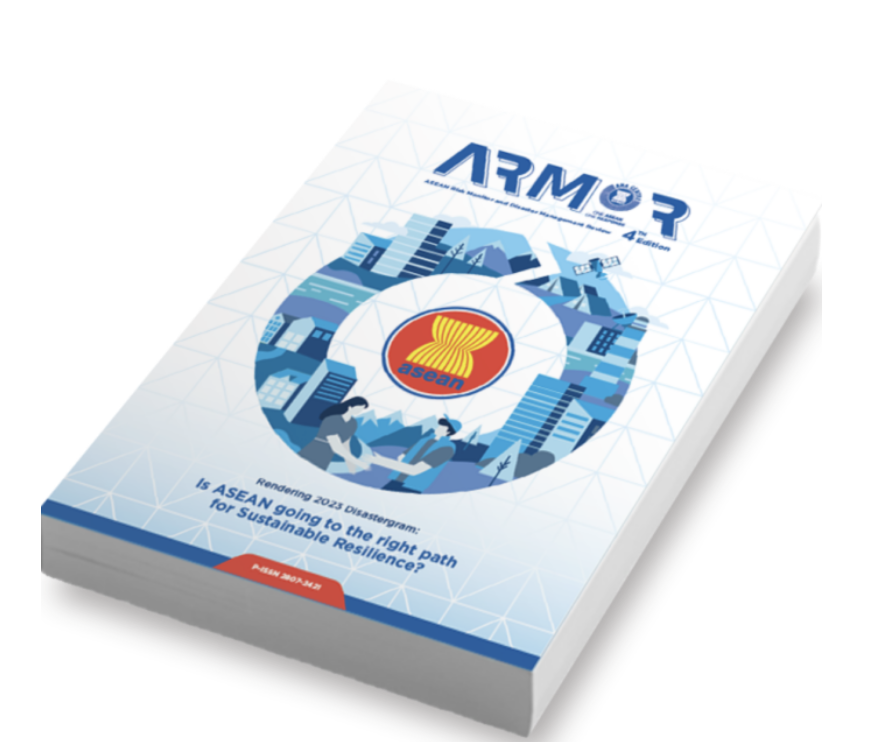
ASEAN Risk Monitor and Disaster Management Review 4 th Edition
Abstract
Southeast Asia continues to present itself as the region most prone to natural disasters. With the effects of climate change becoming more tangible, Southeast Asia, given its geography, will face it’s full force. But beyond the relentless droughts, earthquakes, floods, typhoons and tsunamis, the nature of disasters is evolving, to the extent new threats such as the recent Covid19 pandemic have emerged. But with these disasters not only continuing to plague humanity, but also growing in its ability to threaten both urban and rural populations, Southeast Asia’s ability to withstand these challenge, and whether this resilience is sustainable, will be put to the test.
In alignment with the ASEAN Vision 2025 on Disaster Management, ASEAN endeavours to enhance its capacity to respond effectively to disasters and demonstrate global leadership in disaster management by 2025. The AHA Centre, in its mission to support ASEAN’s endeavours in disaster response and management, introduces the 4th edition of the ASEAN Risk Monitor and Disaster Management Review (ARMOR), titled: “Rendering 2023 Disastegram: Is ASEAN going to the right path for Sustainable Resilience”
The 4th edition of ARMOR, through the contributors in this edition, will underline the importance of strengthening sustainable disaster resilience in Southeast Asia, and offer suggestions and improvements that can be made to existing approaches and initiatives. The contributions offer multifaceted insights that encompasses culture, education, the use of data and technology, as well as government policies to highlight the steps needed to achieve sustainable disaster resilience in the region.
Building Sustainable Resilience: Navigating Systemic Risks, Enhancing Resilience: elaborates on the concept of Sustainable Resilience which was introduced by the President of Indonesia with aims to address complex issues and strengthen climate and disaster resilience while aligning with global agendas.
ASEAN Disaster Risk Sustainable Resilience: Incorporating Sustainable Development Goals into ASEAN Riskscape assesses the latest disaster risk of the ASEAN region and incorporates the Sustainable Development Goals (SDGs) as components to build resilience. The assessment seeks to understand the impact of sustainable development efforts on the ASEAN Riskscape.
The Disaster-Threat Passivity Phenomenon: A Concept Analysis investigates human passivity and indifference towards the threat of disasters. In particular, it investigates the reasons for human passivity and offers cross-dimensional solutions to address it.
Towards Better Information for Improved Disaster Risk Management in Southeast Asian: Informal Settlements recognises the exacerbated threat and risks disasters have to informal settlements in Southeast Asia and studies how the use of nature-based solutions may benefit these communities. The article also explores how technology can be utilised to evaluate and support nature-based solutions , through the use of low-cost environmental sensors, IT tools for citizen space and satellite remote sensing.
Enhancing Sustainable Disaster Management Solutions on Displacement in Southeast Asia using Data-Driven Approaches: using Data-Driven Approaches compiles varying forms of data to assess the impact disasters have on displacement across different Southeast Asian nations. By collecting and analysing data, the article also identifies factors and areas the targeted Southeast Asian nations have to take into consideration in mitigating disaster-induced displacement.
Catalysing Adaptive Social Protection for Sustainable Resilience – in Southeast Asia: Gaps, Stakeholders, and Policy Mechanisms: draws attention to lapses in ASEAN member state’s approaches to Adaptive Social Protection. It highlights the importance of involving multi-sector stakeholders, accompanied by all-encompassing socio-economic data, in the design and planning of programmes catered to enhancing social protection, disaster-risk reduction and climate change adaptation strategies. It also recommends adopting Disaster-Risk Financing to encourage greater protection from and facilitate human adaptability and resilience towards disasters.
Unveiling the ASEAN-Civil Society Partnership: Navigating Disaster Resilience through Collaboration: identifies the areas ASEAN and ASEAN member states have collaborated with Civil Society Organisations on, specifically in relation to disaster risk reduction and management. The article underlines how these partnerships has contributed to improvements in the region’s Disaster Resilience, but also offers recommendations for greater ASEAN-Civil Society interactions.
Community-Based Disaster Risk Reduction in Rakhine State, Myanmar: examines the benefits of Community-Based Disaster Risk Reduction (CBDRR) strategies in improving disaster preparedness and response and enhancing sustainable disaster resilience. Noting the challenges faced in Rakhine State, it encourages greater involvement of ASEAN, international organisations and local stakeholders in Community-based Disaster Risk Reduction.
Anticipatory Action for Disaster Management and Sustainable Resilience: Lessons from ASEAN Countries. reinforces the need for Anticipatory Action as a key mechanism of Disaster Risk Reduction and Management. It reflects on actions disaster management stakeholders in Southeast Asia can take to advance the Anticipatory Action agenda, in order to consolidate and build-on the region’s disaster resilience.
Policy Research for Policy Proposal for the People: Drought Modelling for Post Disaster Needs Assessment in Thailand endeavors to construct a drought assessment model tailored for application within the context of Post-Disaster Needs Assessments (PDNA). The Thai National Research Council supported this research as a pilot project in four Northeastern provinces: Nakhon Ratchasima, Chaiyaphum, Buriram, and Surin. The study’s core concept involves the development of a drought model that harnesses satellite imagery and indices in conjunction with in-depth interviews to extract socio-economic factors, thereby enhancing the quality of outcomes for policymaking.
Supported by :